Why Most Leadership Development Falls Short: And What Sustainable Leadership Requires Now

Organizations invest heavily in leadership development. Assessments are administered. Models are taught. Frameworks are shared.
Yet leaders are more exhausted, reactive, and overwhelmed than ever.
Decision quality declines under pressure. Trust inside teams is fragile. Burnout is quietly normalized as the cost of leadership.
The issue is not a lack of leadership knowledge.
The issue is that leadership development has failed to address how humans actually lead under pressure.
The Leadership Problem We Rarely Name
Most leadership development focuses on what leaders should do. Skills. Behaviors. Competencies.
But leadership does not break down in calm conditions. It breaks down under stress, uncertainty, and sustained demand.
When pressure is high, the nervous system shifts into protection. Perception narrows. Reactivity increases. Leaders default to overthinking, overcontrolling, or overworking.
This is not a character flaw. It is biology.
Wellsiliency® Insight: Leadership effectiveness is not just a skill issue. It is a regulation and integration issue.
Until leadership development addresses the human system beneath behavior, insight alone will continue to plateau. Too often, organizations invest in shallow training that stops at diagnosis rather than equipping leaders and teams to transform how they lead and work together.
The Root Cause: Leaders Are Listening to Parts of Themselves, Not the Whole
Under stress, leaders tend to over-rely on cognitive or Head Intelligence. Analysis, logic, and strategy dominate decision-making, anchored in “what they know.”
At the same time, other critical forms of intelligence are muted.
Emotional attunement weakens.
Values clarity erodes.
Instinct and identity lose their voice.
The body’s signals are ignored.
The result is leadership that may appear competent on the surface, yet lacks depth, adaptability, and sustainability long-term under pressure.
Wellsiliency® Insight: Awareness without integration does not change behavior.
Where Emotional Intelligence Falls Short on Its Own
Emotional Intelligence has long been recognized as a critical leadership capability. Research consistently shows that leaders who demonstrate self-awareness, self-regulation, empathy, and social skill outperform those who rely on cognitive intelligence alone.
Yet even emotionally intelligent leaders struggle under sustained pressure.
Why?
Because Emotional Intelligence describes what effective leadership looks like, but not always how leaders access those capacities when stress, identity threat, or nervous system dysregulation is present.
Wellsiliency® Insight: Emotional Intelligence reflects leadership capability. Whole-Self Intelligence™ develops the capacity to access it under pressure.
Whole-Self Intelligence™ supports and extends Emotional Intelligence by integrating the intelligences that shape self-awareness, self-regulation, decision-making, and relational presence in real time. When leaders are regulated and integrated, Emotional Intelligence becomes embodied rather than aspirational.
Why Traditional Leadership Development Plateaus
Most programs, including ours, do many things well.
They increase awareness. They teach shared language. They offer valuable assessments.
But sustained behavior change? That’s not so easy.
Without addressing stress, identity, nervous system regulation, and embodiment, leadership tools remain conceptual rather than operational.
Leaders know what good leadership looks like but cannot consistently access it under pressure.

The Wellsiliency® Difference
Wellsiliency® is where resilience, wellbeing, and embodied self-leadership converge to enable sustainable performance.
Rather than adding more tools, Wellsiliency® develops the capacity of the leader.
Wellsiliency® Insight: Before leaders can decide well, they must regulate. Before teams can perform well, they must integrate.
This work shifts leadership development from performance at all costs to performance that endures.
Whole-Self Intelligence™: An Embodied Leadership Approach
Whole-Self Intelligence™ describes the operating capacity guiding leaders in how to be, decide, and lead effectively under pressure. It integrates five intelligences leaders already possess but often underutilize or overuse. When integrated, leaders are able to lead with clarity, trust, and resilience under pressure.
Strengths Intelligence How innate talents drive performance or undermine it through overuse or underuse
Head Intelligence Strategic thinking, systems awareness, planning
Heart Intelligence Emotional attunement, values alignment, trust, ethics
Gut Intelligence Identity, boundaries, courage, adaptive action
Somatic Intelligence Nervous system regulation, embodied presence, capacity
Whole-Self Intelligence™ enables leaders to regulate before deciding, integrate before acting, and lead from wholeness rather than survival.
How We Use Leadership Tools Differently
Wellsiliency® integrates proven tools but does not confuse them with transformation.
DiSC® surfaces communication patterns and stress responses
CliftonStrengths® reveals how talent shows up in optimal, overused, or underused states
The Five Behaviors® of a Cohesive Team highlights trust, conflict, commitment, accountability, and results gaps
The assessment results are not the end point.
We use them as entry points to go deeper. Whole-Self Intelligence™ is used to elicit and integrate innate intelligence wisdoms from the head, heart, gut, strengths, and soma. These intelligences inform leaders how to authentically be while applying leadership skills that strengthen trust, decision quality, accountability, and results.
Wellsiliency® Insight: Tools diagnose. Integration transforms.
The Pain Points We Solve
For leaders:
Decision fatigue and second-guessing
Chronic overdrive and over-functioning
Strengths that become liabilities under stress
Disconnection from intuition, values, and purpose
For teams and organizations:
Low trust masked by politeness
Avoidance of productive conflict
Weak accountability follow-through
Burnout among high performers
Wellsiliency® Insight: We do not just develop leaders. We restore their capacity to lead.
The Science Behind Whole-Self Intelligence™
And Why It Matters Now
Whole-Self Intelligence™ is grounded in neuroscience, strengths psychology, somatic research, and organizational science.
Research consistently shows that stress impairs decision-making, narrows perception, and reduces relational capacity. Emotion and bodily signals are essential to sound judgment. Regulation precedes clarity.
As artificial intelligence accelerates cognitive output, human intelligence becomes the differentiator.
Wellsiliency® Insight AI can accelerate thinking. It cannot regulate the human nervous system.
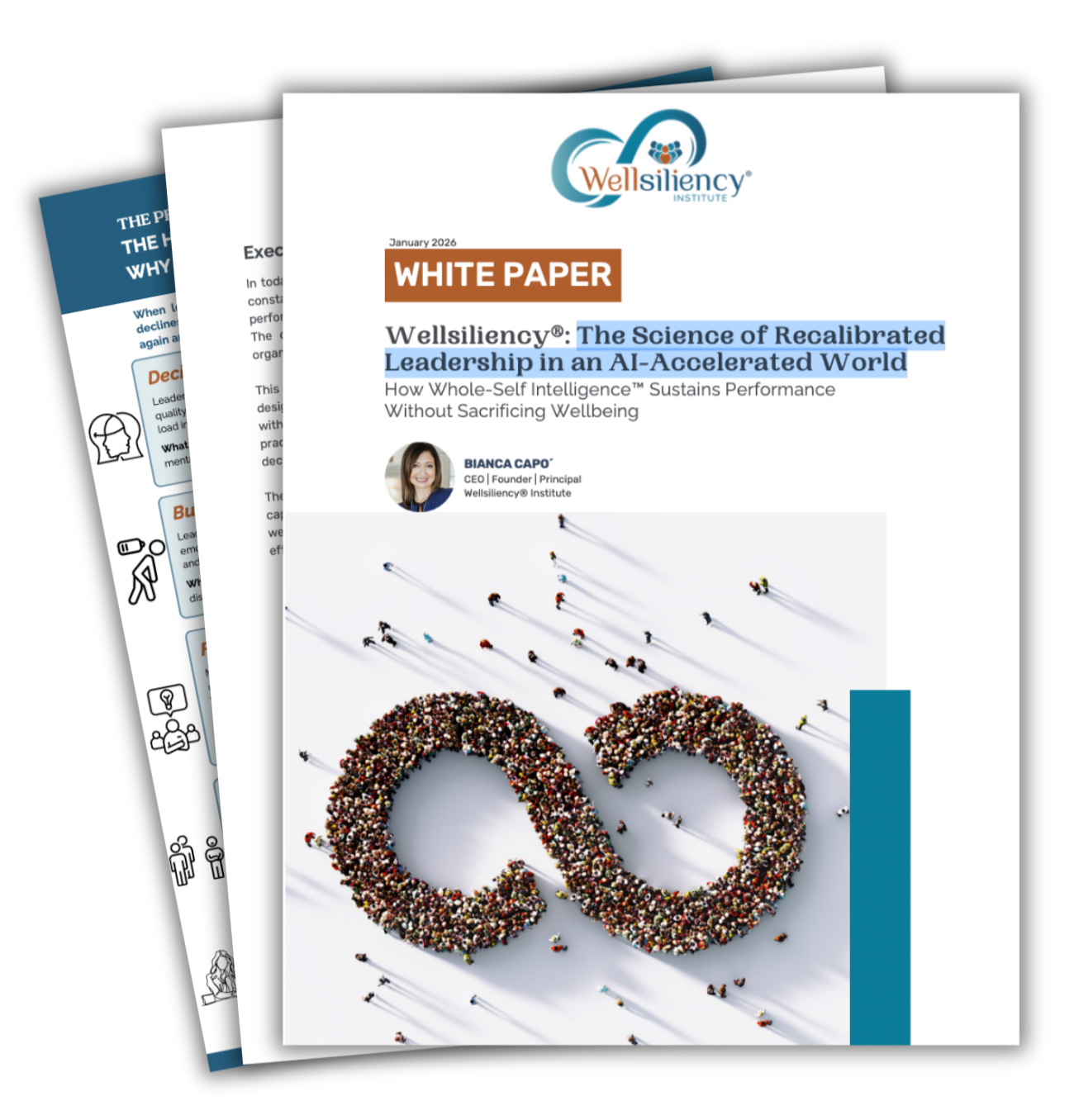
📄 Download the White Paper:
Wellsiliency®: The Science of Recalibrated Leadership in an AI-Accelerated World
This paper contrasts AI with Whole-Self Intelligence™ and explains why leadership without integration is no longer viable.
Why Organizations Choose Wellsiliency®
Organizations partner with Wellsiliency® because this work addresses the root cause. It integrates science, embodiment, and performance. It produces sustainable behavior change. It supports leaders where pressure actually lives.
Wellsiliency® Insight: Leadership development that ignores the human system will always underperform in the real world.
References (APA)
Damasio, A. (1994). Descartes’ Error — Emotion and bodily signals are essential to rational decision-making.
Goleman, D. (1995; 1998). Emotional Intelligence; Working with Emotional Intelligence — Self-awareness, self-regulation, empathy, and social skill are core leadership capabilities.
Goleman, D. (2006). Social Intelligence — Human relationships and emotional attunement directly impact leadership effectiveness.
Porges, S. (2011). The Polyvagal Theory — Nervous system regulation shapes perception, behavior, and relational capacity under stress.
Soosalu, G., & Oka, M. (2012). mBraining — Multiple intelligences beyond cognition inform leadership, decision-making, and performance.
Buckingham, M., & Clifton, D. (2001). Now, Discover Your Strengths — Talent awareness and deployment drive engagement and performance.
Lencioni, P. (2017). The Five Dysfunctions of a Team — Trust, conflict, commitment, accountability, and results are foundational to team effectiveness.