A Leadership Decision-Making Thesis: Why Strong Analysis Still Fails Under Pressure

“The greatest danger in times of turbulence is not the turbulence; it is to act with yesterday’s logic.”
— Peter Drucker, management consultant and author
The Existential Challenge Inside Modern Leadership Teams
Every consequential decision contains tension. Even at the individual level.
A single leader weighing a major decision is synthesizing:
Data. Risk. Values. Reputation. Relational consequences. Timing. Capacity. Uncertainty.
That internal complexity is already significant.
When a leader lacks internal regulation, pressure narrows thinking. Analysis sharpens. Judgment constricts.
But now imagine that complexity multiplied.
In a team, each member brings:
• Their own interpretation of the data
• Their own values hierarchy
• Their own risk tolerance
• Their own emotional state
• Their own reputation concerns
• Their own nervous system under pressure
Integrated strategic judgment at the individual level is already demanding.
At the team level, it becomes exponentially more complex.
“Management is doing things right; leadership is doing the right things.”— -Peter Drucker
What Is Integrated Strategic Judgment?
Analysis answers: What does the data say?
Integrated judgment answers: What does this mean for us, long term, relationally, culturally, operationally, financially -given our real capacity under sustained pressure?
Analysis sharpens thinking.
Integrated judgment stabilizes direction.
“None of us is as smart as all of us.”— Ken Blanchard.
Individual vs Collective Decision Architecture
When under pressure, whether in a traditional hierarchy or a modern lateral team, judgment narrows. Dominant analysis takes over. Unspoken tension shapes the room. Individual stress states influence collective direction. The loudest logic wins. The fastest answer sticks. The appearance of alignment replaces true integration.
This is where strong analysis fails - not because it is wrong, but because it is incomplete.
“We are blind to our blindness.” -Daniel Kahneman, Nobel Laureate in Economics
The Thesis
Teams often equate intelligence with integration, assuming that strong analysis guarantees sound strategic judgment.
It does not.
Analytical rigor and intelligence strengthen thinking.
Integrated strategic judgment strengthens decisions.
There is a difference.
Research across neuroscience and organizational psychology suggests that analytical strength does not protect teams from reactive decision patterns.
Integration and regulation do.
When pressure rises, even smart teams default to analysis over judgment. And the cost compounds over time.
Without integration, decision quality becomes quietly shaped by stress physiology, narrowed cognition, and unexamined resistance patterns -often without the team realizing it.
“Emotion is not a luxury. It is a crucial component of rational thinking.” — Antonio Damasio, MD, neuroscientist and author of Descartes’ Error
Why This Happens
Under sustained pressure, physiology changes.
Cognitive flexibility narrows. Speed increases. Tolerance for ambiguity decreases. Listening becomes selective.
Daniel Kahneman’s work on cognitive load demonstrates that under stress, fast, automatic thinking dominates. Nuance drops.
Antonio Damasio’s research showed something even more striking: individuals with impaired emotional processing could reason logically, yet consistently made poor real-world decisions. His conclusion was clear — rationality depends on emotion and bodily signals.
In other words: Intelligence does not override physiology.
Stephen Porges’ polyvagal research further explains why regulation precedes cognitive flexibility. When leaders are dysregulated, integration drops.
Richard Boyatzis’ work on resonant leadership demonstrates that stress shifts leaders into defensive emotional states that impair complex relational and strategic thinking.
Amy Edmondson’s research on psychological safety shows that high-performing teams outperform not because of IQ concentration, but because of how effectively they integrate diverse perspectives.
Across neuroscience and organizational research, the pattern is consistent:
Analytical strength does not protect teams from reactive decision patterns. Integration and regulation do.
In Part II, I’ll outline what integrated strategic judgment requires - and why most leadership teams have never been trained in it.
Bianca Capo Founder, Wellsiliency® Institute www.wellsiliency.com
Bianca partners with executive leaders and organizations to strengthen integrated decision-making and protect sustainable leadership performance through Wellsiliency® @Work™ — The Sustainable Leadership Performance System. Her work integrates embodied leadership, Whole-Self Intelligence™, and strengths-based development to stabilize decision-making, elevate culture, and protect both results and people under pressure.
If strengthening your leadership team’s decision architecture is a priority this year, connect with Bianca directly on LinkedIn or email info@wellsiliency.com to schedule an executive briefing.
References
Damasio, A. R. (1994). Descartes’ error: Emotion, reason, and the human brain. Putnam.
Edmondson, A. (2018). The fearless organization. Wiley.
Kahneman, D. (2011). Thinking, fast and slow. Farrar, Straus and Giroux.
Boyatzis, R., & McKee, A. (2005). Resonant leadership. Harvard Business School Press.
Porges, S. W. (2011). The polyvagal theory. Norton.
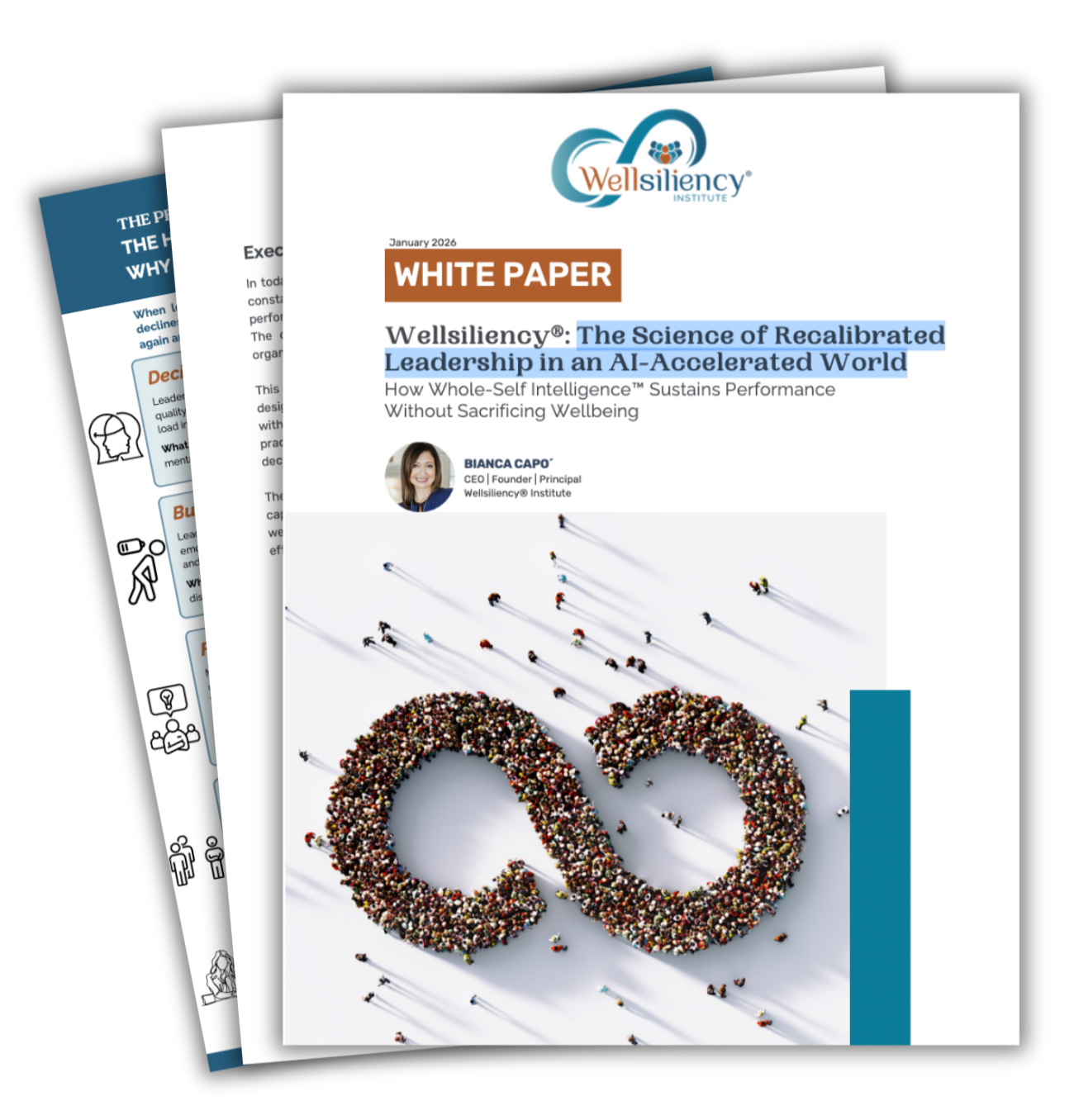
FREE WHITE PAPER
Wellsiliency®: The Science of Recalibrated Leadership in an AI-Accelerated World How Whole-Self Intelligence™ sustains performance without sacrificing wellbeing
The future does not belong to those who learn AI alone. It belongs to those who learn how to integrate their inner intelligences well enough to use AI wisely.