Is Pressure Leading You? How to Know When It’s Time to Recalibrate
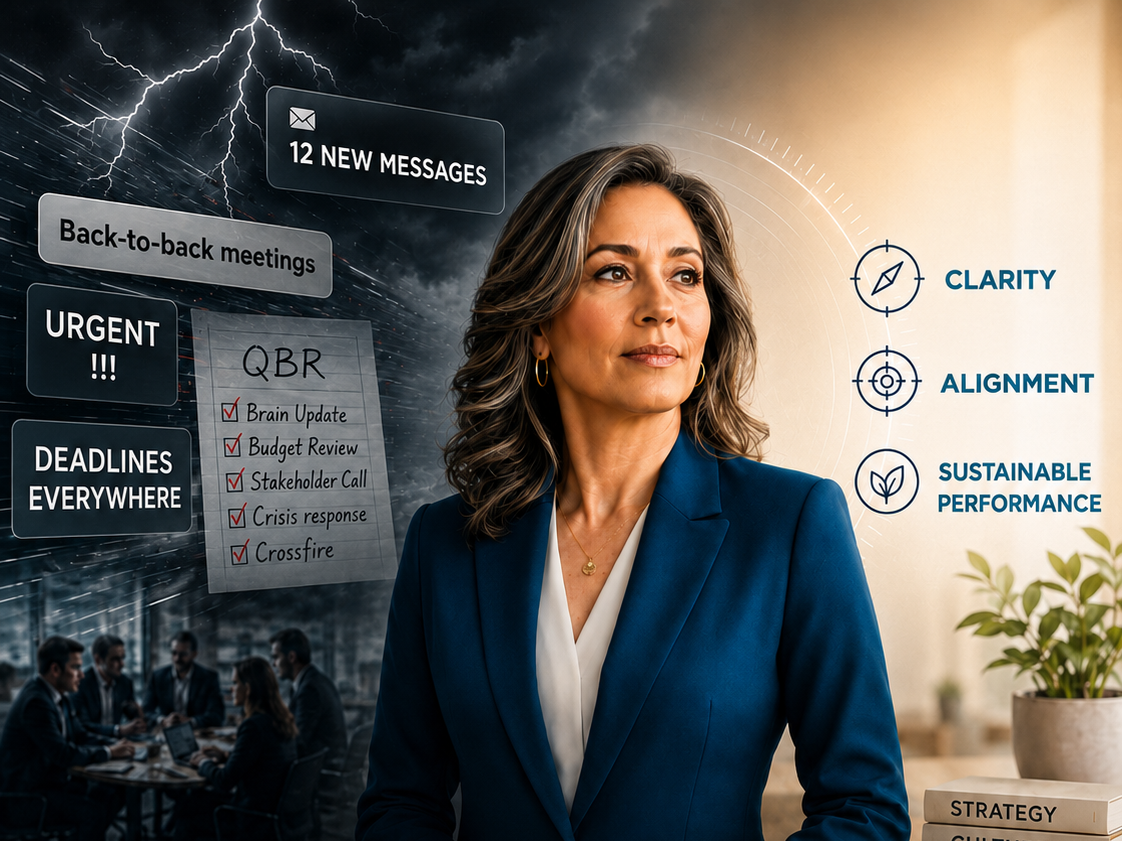
There is a kind of pressure leaders carry that rarely shows up on a dashboard.
It lives in the hard conversation being delayed. The decision that keeps circling. The team tension everyone feels but no one names. The high performer who is still producing but quietly disengaging. The manager who wants to lead well but is operating from exhaustion, urgency, or self-doubt.
For too long, organizations have treated pressure, including the ongoing demands, uncertainty, complexity, and emotional load leaders carry, as the price of performance.
And to be clear, pressure is not the enemy.
Unexamined pressure is.
Pressure can reveal where leadership capacity needs to grow. It exposes patterns, decision habits, nervous system reactions, communication gaps, trust fractures, and cultural strain. In other words, pressure becomes diagnostic. It shows us where recalibration is needed.
The challenge is that everyone has a different capacity for pressure. What feels energizing to one person may feel destabilizing to another. What one leader can process with clarity, another may experience as urgency, shutdown, over-functioning, or emotional fatigue.
That does not mean one leader is stronger and the other is weaker.
It means pressure is personal.
And how we respond to it matters.
How Do You Know When It’s Time to Recalibrate?
Most leaders do not realize pressure is negatively impacting them until the consequences become visible. The relationship is strained. The team has gone quiet. The decision has been delayed too long. The body is exhausted. The leader is still functioning, but no longer leading from their clearest self.
That is often the first sign.
You may still be performing, but something in the way you are performing has changed.
You may need to recalibrate when small things feel heavier than they should. When your decisions are driven more by urgency, fear, proving, or avoidance than clarity and alignment. When you are having the same internal conversation repeatedly but not taking action.
You may notice yourself over-explaining, over-carrying, over-controlling, or over-functioning. Your body may feel tense, tired, restless, or unable to fully recover. You may still be producing results, but feel less connected to the people, purpose, or values behind the work.
You may be struggling to tell the truth, set a boundary, delegate with trust, or make the decision you already know needs to be made.
These are not signs of failure.
They are signals.
Pressure is giving you information.
The question is whether you are willing to listen before pressure shapes the culture: chronic reactivity, blurred boundaries, delayed conversations, quiet disengagement, eroded trust, and performance sustained at the expense of wellbeing.
Leadership Pressure Is a Culture Issue
Pressure does not stay contained.
It shapes decisions. It affects trust. It changes how leaders communicate, collaborate, delegate, listen, recover, and respond. Left unaddressed, pressure moves from the individual to the team, and from the team into the culture.
Most organizations do not have a performance problem separate from a leadership capacity problem. They do not have a collaboration problem separate from the quality of trust, communication, and decision-making happening every day.
When leaders are reactive, teams become guarded. When decisions lack clarity, execution becomes fragmented. When hard conversations are avoided, trust erodes quietly. When urgency becomes the operating rhythm, people learn to confuse depletion with commitment.
And when people no longer feel like they matter, culture shifts long before the metrics reveal the full cost.
That is why leadership development must evolve.
It is no longer enough to teach communication, accountability, feedback, or collaboration as isolated skills. Those skills matter, but under real pressure, leaders do not rise to a workbook. They default to their patterns.
The deeper work is helping leaders understand what is driving their decisions in real time, so they can lead from clarity instead of reactivity, alignment instead of over-functioning, and trust instead of self-protection.
That is where leadership capacity is built.
The Pressure Recalibration Assessment: Score Yourself Before Pressure Scores You
The next time pressure rises, don’t just ask, “How do I get through this?”
Use it as a diagnostic.
Rate yourself on each statement below using this scale:
1 = Rarely true2 = Sometimes true3 = Often true4 = Almost always true
Self-Assessment
Under pressure, I can clearly distinguish between reacting and responding.
I address hard conversations in a timely way instead of delaying them.
I know the difference between what is mine to carry and what belongs to others.
I can identify where trust is strong and where it may be strained on my team.
I notice what my body is telling me (tension, fatigue, restlessness, shutdown) and respond accordingly.
My decisions are grounded in clarity and alignment, not urgency, fear, or proving.
I can delegate without over-controlling or over-functioning.
I recover well after high-pressure moments instead of carrying them forward.
My communication remains clear, direct, and emotionally intelligent under stress.
I can identify what leadership capacity a difficult moment is asking me to strengthen.
YOUR SCORE:
Add your total score.
10–19: High Risk of Reactive Leadership Pressure may be leading you more than you realize. This range often signals chronic over-functioning, avoidance, emotional fatigue, or decision-making driven by urgency rather than clarity. Recalibration is needed now. Left unaddressed, this can impact trust, wellbeing, and team performance.
20–29: Functional but Fractured You are likely still performing, but pressure may be creating hidden costs. This range often reflects inconsistent boundaries, delayed conversations, or carrying too much responsibility. You may be sustaining results, but not sustainably. This is the range where many leaders normalize strain, and strain always has a cost.
30–35: Stable but Stretched You have meaningful leadership capacity, but pressure is revealing growth edges. You are likely self-aware and capable, but there may still be patterns of over-carrying, tension, or relational blind spots. This is the ideal range for intentional recalibration before pressure compounds.
36–40: Recalibrated Leadership Capacity You are demonstrating strong pressure resilience and embodied leadership. This does not mean pressure is absent. It means you are able to stay clear, regulated, aligned, and trustworthy while navigating it. Your challenge now is maintaining this capacity by identifying the recalibration practices that are sustaining you, understanding how they are elevating your decision quality and relationship dynamics, and intentionally optimizing and rotating them as demands evolve.
What Your Score Means
This is not a pass-or-fail test.
It is a pressure diagnostic.
Your score reveals how pressure may be shaping your leadership in real time. The lower the score, the more likely pressure is driving your patterns. The higher the score, the more likely you are leading pressure instead of being led by it.
Because pressure is never neutral.
It always reveals something.
The question is whether you are willing to use it as information before it becomes consequence.
Why This Work Is Personal for Me
I did not arrive at this work through theory alone.
What has been constant in my life is the need to self-lead through evolution.
From humble beginnings, to learning how to thrive in a financial services consulting and advising career, to rebuilding my professional path through consulting, coaching, facilitation, and leadership development, I have had to hold a vision for what was possible and keep becoming the person my next chapter required.
Not perfectly.
Courageously.
I have coached, consulted with, and advised thousands of people as they discerned personal and professional decisions in complex environments filled with competing priorities, identity tensions, relational dynamics, organizational pressure, and real-life consequences.
I know what it means to be trusted as an advisor, facilitator, coach, strategist, and problem solver because I can see both the human story and the organizational pattern.
I also know what it means to learn that our greatest capacities must be led, not simply used.
Vision without regulation = urgency.
Drive without recovery = depletion.
Courage without alignment = force.
Responsibility without boundaries = over-functioning.
Strategic insight without embodiment = analysis that never fully changes behavior.
That has been part of my own work.
At different points in my life and career, I have had to courageously lead myself back to the truth of who I am, how I am designed to contribute, and what kind of work I am actually here to do.
That is why Wellsiliency® is not an abstract brand promise to me.
It is lived. Practiced. And continually refined.

The Promise of Wellsiliency®
Wellsiliency® @Work develops the leadership capacity organizations need to sustain performance, strengthen collaboration, and protect culture under pressure.
Wellsiliency® is resilience elevated into embodied leadership performance: the capacity to stay clear, regulated, aligned, emotionally intelligent, and trustworthy under pressure.
This is not wellness dressed up for the workplace. It is leadership development for the pressure leaders are actually carrying.
And the pathway into that capacity is The Recalibrated Leader™.
The Recalibrated Leader™ is the flagship Wellsiliency® leadership development experience designed to help leaders recognize the patterns driving their decisions under pressure, recalibrate how they lead, and strengthen the capacity to perform without sacrificing trust, wellbeing, or culture.
The future will not be served by leaders who can simply endure more.
It will require recalibrated leaders who can stay clear, regulated, aligned, emotionally intelligent, and trustworthy when the pressure is real.
If pressure is showing up in your organization through unclear decisions, strained communication, low trust, burnout, disengagement, retention concerns, or inconsistent execution, the issue may not be a lack of effort.
Your leaders may need a stronger system for transforming pressure into clarity, collaboration, and sustainable performance.
The Recalibrated Leader™ can be brought into your organization through Wellsiliency® @Work as a leadership retreat, management development experience, team effectiveness pathway, or culture-aligned program designed to meet the real needs of your organization.
Because performance matters.
So do people.
And the strongest cultures are built by leaders who know how to protect both.
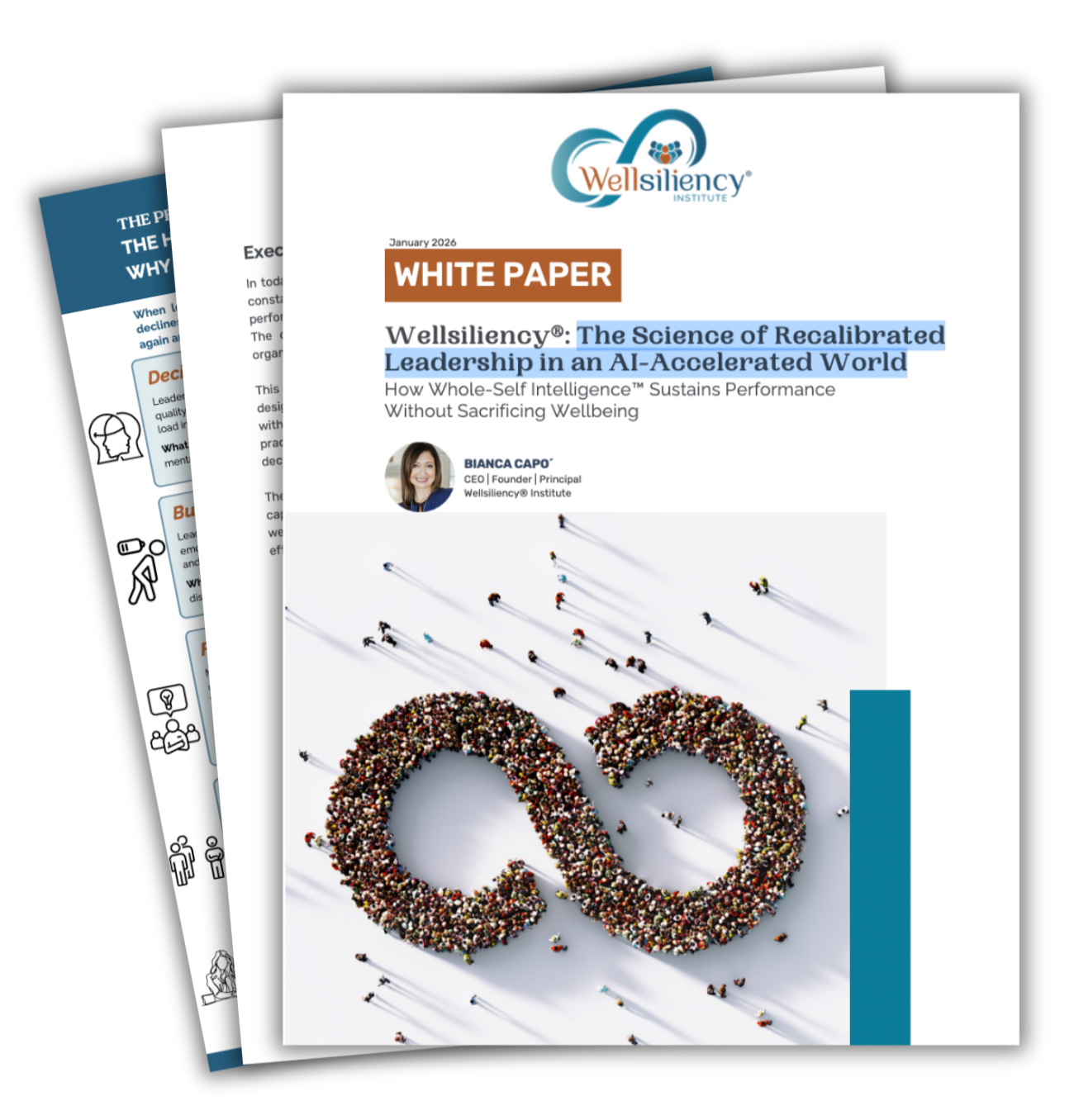
FREE WHITE PAPER
Wellsiliency®: The Science of Recalibrated Leadership in an AI-Accelerated World How Whole-Self Intelligence™ sustains performance without sacrificing wellbeing
The future does not belong to those who learn AI alone. It belongs to those who learn how to integrate their inner intelligences well enough to use AI wisely.